
High-MOI putter engineering and design has fundamentally changed how golfers at every level approach the green, and the numbers back it up: 74.5% of PGA TOUR winners in 2025 used mallet-style, high-MOI putters, with 35 out of 47 champions choosing them over traditional blades. At Ashdon Golf, we have built our entire product line around the science of Moment of Inertia, using geometric engineering principles that most manufacturers have never considered. This guide breaks down exactly what high-MOI design means, why it works, and which putters deliver the most forgiveness, stability, and consistency for your game.
Key Takeaways
|
Question |
Answer |
|---|---|
|
What does MOI stand for in putter design? |
MOI stands for Moment of Inertia, which measures a putter head's resistance to twisting on off-center hits. Higher MOI means the face stays squarer at impact, even on mishits. |
|
What makes a putter "high-MOI"? |
A putter earns the high-MOI label when its head weight is distributed to the perimeter (heel and toe), dramatically increasing resistance to face rotation during the stroke. |
|
Are high-MOI putters legal for tournament play? |
Yes. Our Ashdon Golf putters hold USGA approval and have been competition-legal since receiving patent clearance. Founder Ronnie Pritchett spent three years securing both the patent and USGA sign-off. |
|
Which Ashdon putter has the largest sweet spot? |
The Bermuda Triangle Long Island Mallet is engineered with the largest sweet spot in our lineup, allowing solid contact anywhere inside the triangle connection. |
|
What is the difference between the Bermuda Triangle and Roundabout series? |
The Bermuda Triangle series uses a triangular heel-to-toe connection, while the Roundabout series uses a circular connection exactly the size of a golf ball (1.68 inches) for alignment simplicity. |
|
How much does high-MOI engineering improve accuracy? |
Our design claims an 87% larger effective sweet spot compared to any other putter on the market, which directly reduces the distance penalty on mishits. |
|
Do professionals use high-MOI putters? |
Absolutely. As of 2026, 80% of the world's top 5 ranked players have transitioned to high-MOI mallet designs, confirming that performance engineering has overtaken tradition at the elite level. |
What Is High-MOI Putter Engineering and Design?
Moment of Inertia, or MOI, is a physics principle that describes how strongly an object resists rotational force. In putter engineering, it measures how much the head twists when you strike the ball away from the true center of the face.
A low-MOI putter twists easily on mishits, sending the ball offline and costing you distance. A high-MOI design pushes mass out to the extreme edges of the head (the heel and the toe), creating a much wider resistance to that twisting motion.
Typical blade putters measure between 3,500 and 6,000 g-cm² on the vertical axis MOI scale. High-performance high-MOI designs reach 6,000 to 9,000+ g-cm², representing up to a 150% increase in stability at impact. That engineering gap is not cosmetic. It is the difference between a ball that tracks your intended line and one that veers two feet wide.
At Ashdon Golf, our high-MOI putter engineering and design philosophy goes further than simple perimeter weighting. We use two of the strongest geometric shapes in mathematics, triangles and circles, to connect the heel and toe of the putter head into one unified, rigid structure. This is not something any other manufacturer does. It is our patent-protected method, and it is what drives our claim of an 87% larger sweet spot than any other putter on the market.
The Science Behind High-MOI Putter Engineering and Design
Understanding why high-MOI putter engineering works starts with understanding torque. Every time you take the putter back, the natural tendency of the head is to rotate slightly open or closed relative to the shaft. This is torque during the backswing, and it is a primary cause of pulled and pushed putts.
Most manufacturers address MOI only at the moment of impact. We engineered our putters to stop torque during the backswing itself. The geometric connection between heel and toe creates a rigid frame that resists unwanted rotation from the very start of the stroke. The result is a putter that stays square to your target line through the entire motion, not just at the ball.
Perimeter weighting then adds a second layer of protection. By distributing mass around the outer edges of the head rather than concentrating it in the center, the putter head requires significantly more force to rotate out of plane on an off-center strike. The practical result: on a 30-foot putt, a high-MOI design will leave you roughly 7 inches short on a mishit, while a traditional blade leaves you 20 inches short from the same strike.
Did You Know?
High-MOI "winged" putter designs minimize distance loss to just 2% on a 2cm off-center hit, compared to 5.5% for standard blade and mallet designs.
Source: one-putts.com
How Geometric Engineering Drives Our High-MOI Putter Design
Our approach to high-MOI putter engineering and design is rooted in a simple but powerful observation: the triangle and the circle are the two strongest geometric shapes in existence. A triangle distributes force evenly across three points. A circle has no weak corners or stress points at all. Both shapes are extraordinarily difficult to deform under load.
When we connect the heel and toe of a putter head using one of these shapes, we create a frame that resists collapse, twist, and rotation far more effectively than a conventional flat-back or cavity design. This is what we call geometric engineering, and it underpins every putter we build.
The concept originated in 1993 when our founder, PGA Professional Ronnie Pritchett, watched a well-known player yip a putt on national television. That moment became the engineering problem he spent the next five years solving. The prototype arrived in 1998, and after three years of testing and review, we secured the patent and USGA approval. The "Triangle" connection design now carries an indefinite trademark, and over 10,000 golfers have used it to eliminate 3-putts from their game.
Best High-MOI Putter Designs: The Bermuda Triangle Series
Our Bermuda Triangle series represents the purest expression of triangle-based high-MOI putter engineering. Each model connects at the heel and toe, broadening into a wide triangular frame that keeps the face square to the target from backswing to follow-through.
Bermuda Triangle Ballistic Missile G-360 M5 Mallet ($349.95)
The M5 is our most engineered mallet in the Bermuda Triangle lineup. It carries a total head weight of 380 grams, with perimeter weighting distributed to the extreme edges of the triangular frame.
The result is a high-MOI design that delivers a stable, forgiving stroke without requiring a perfect center strike. The tagline is simple: Balance = Precision. Every engineering decision on this putter supports that formula.
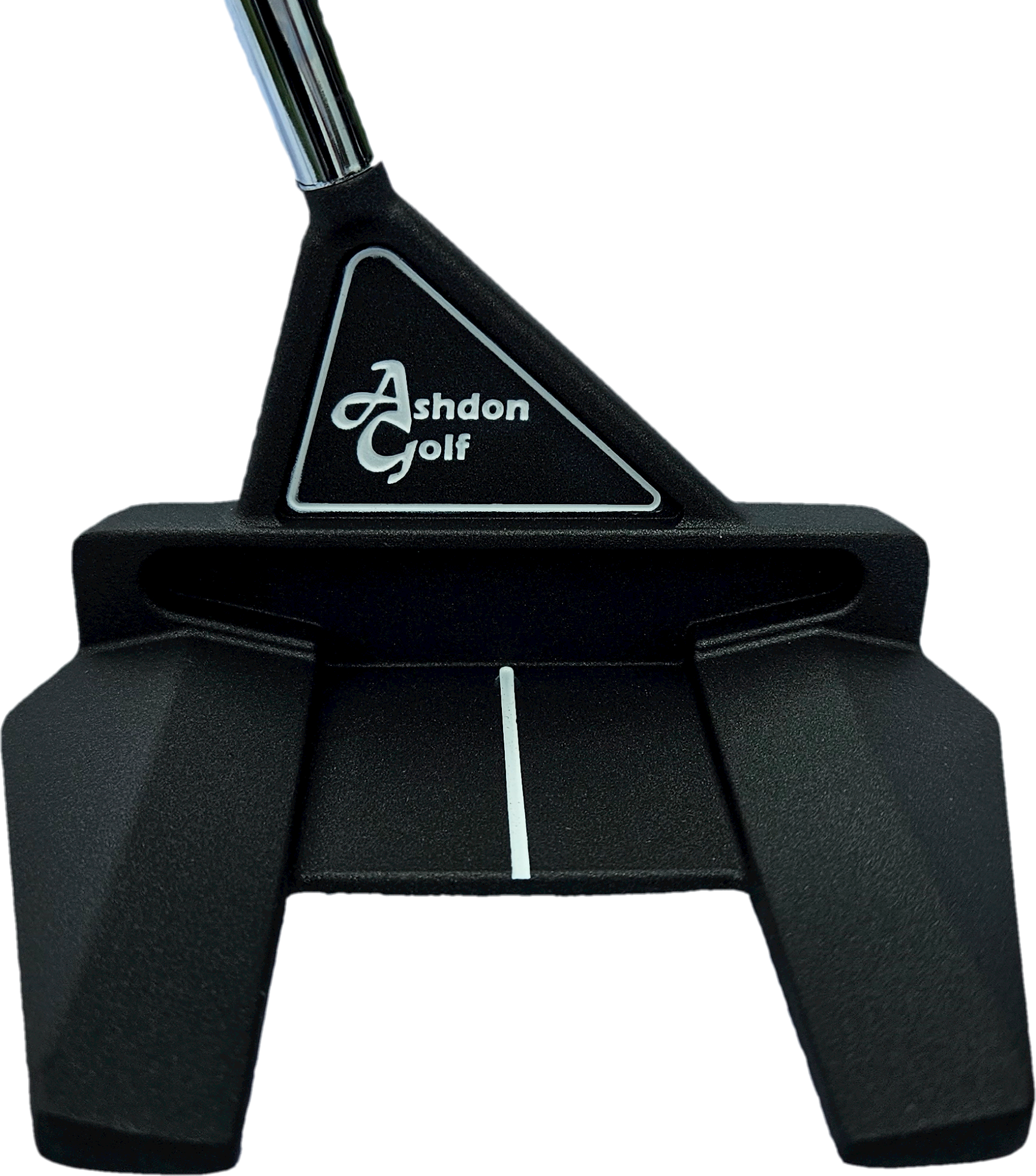
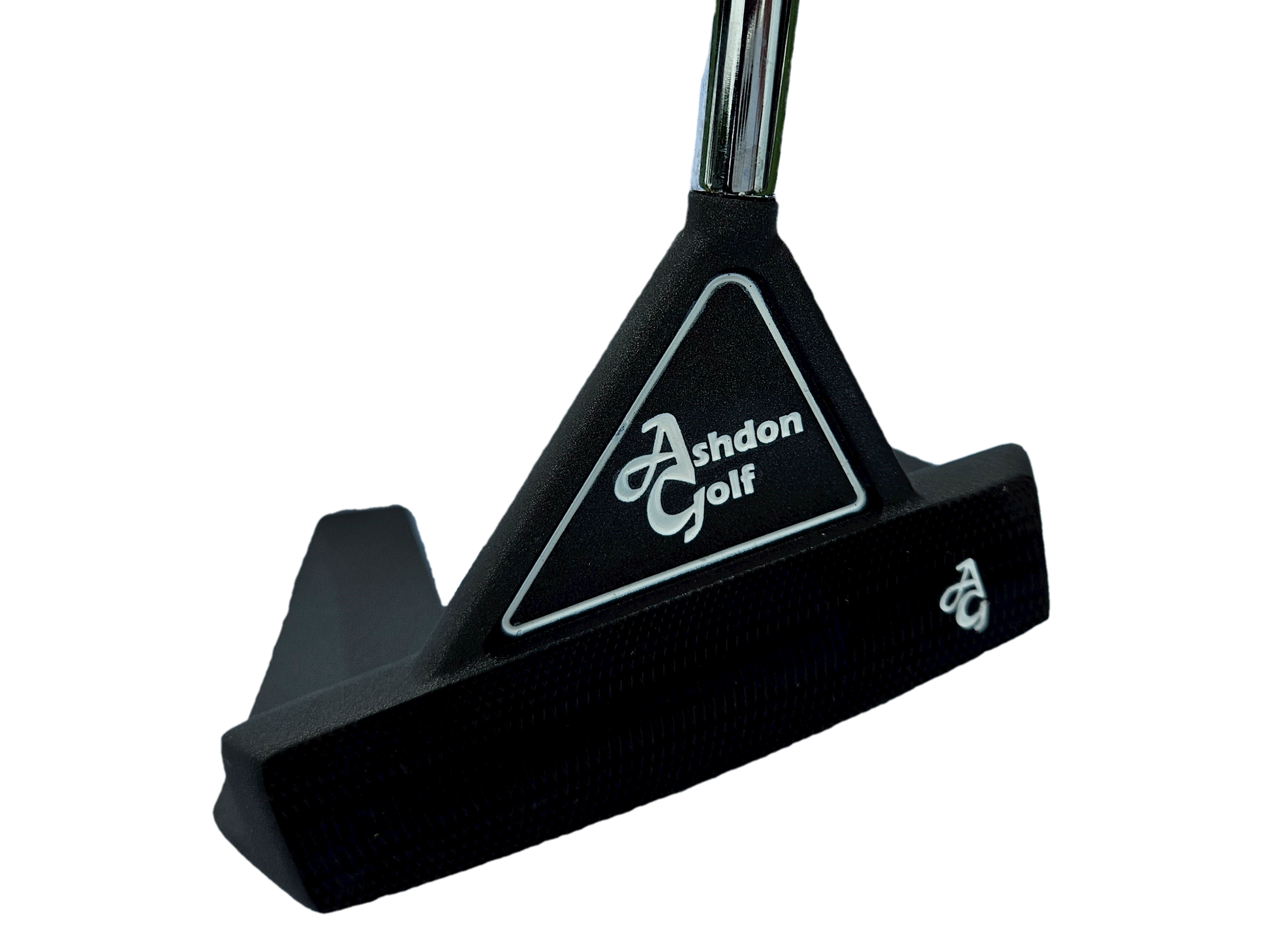
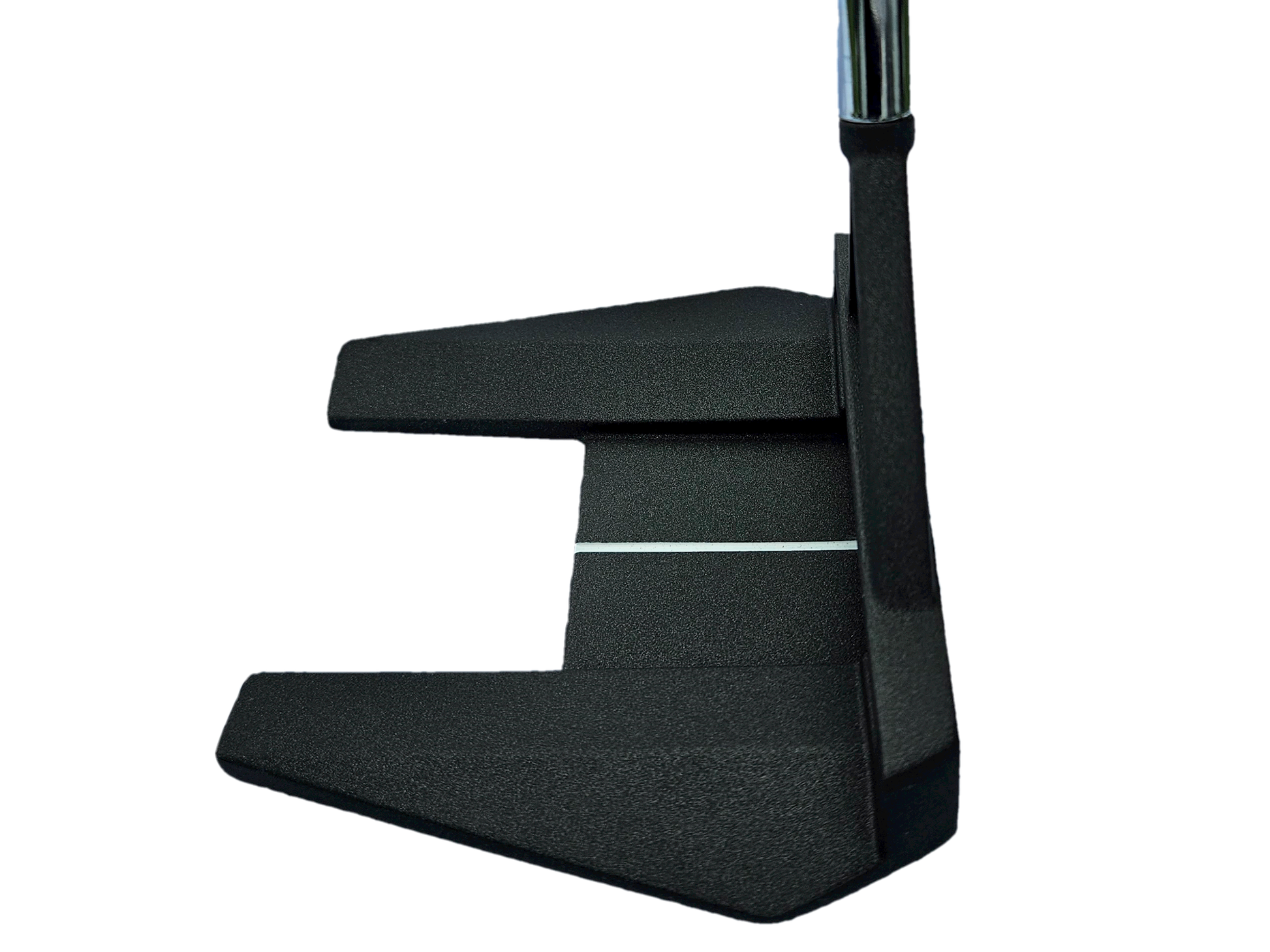
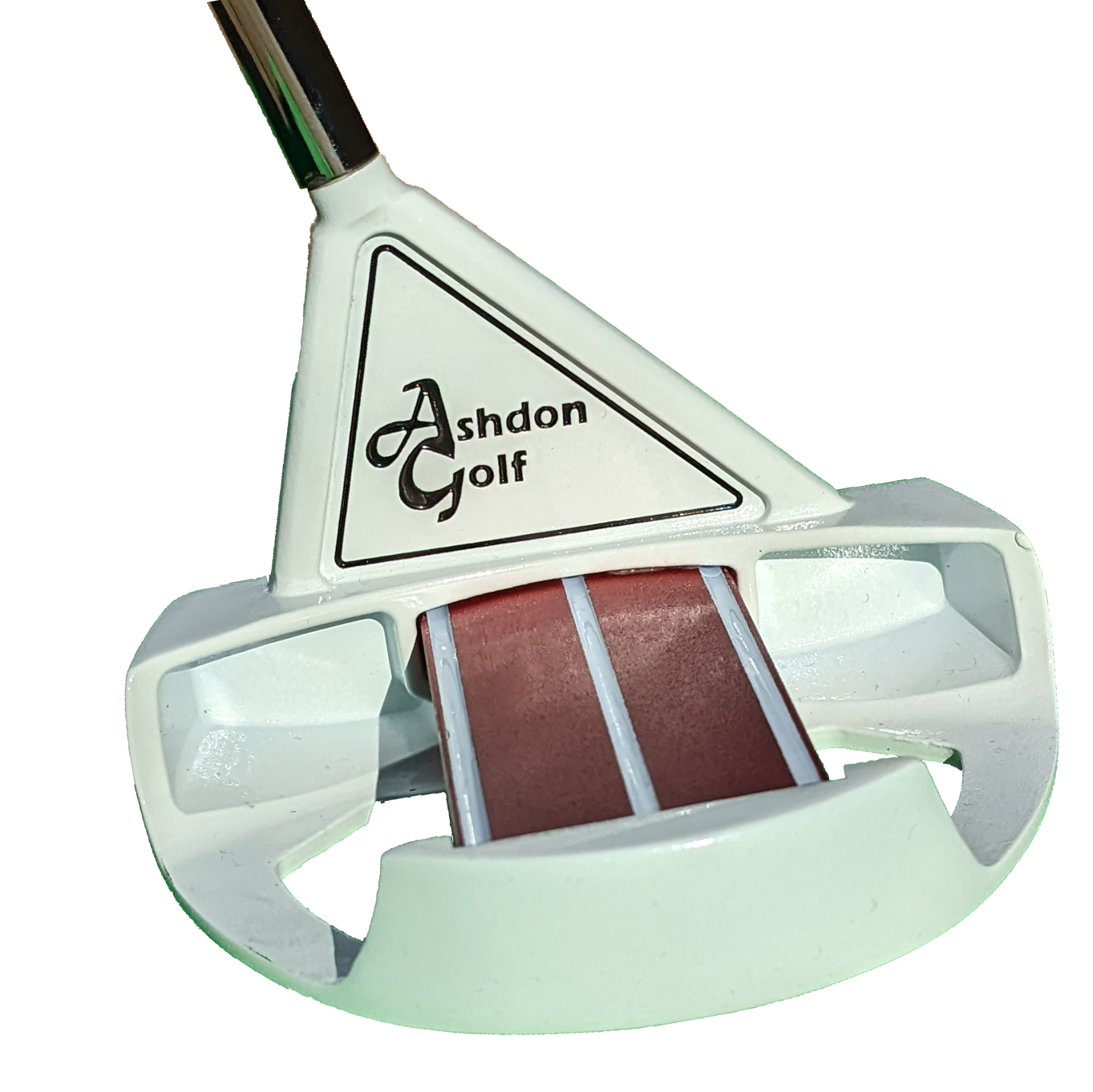
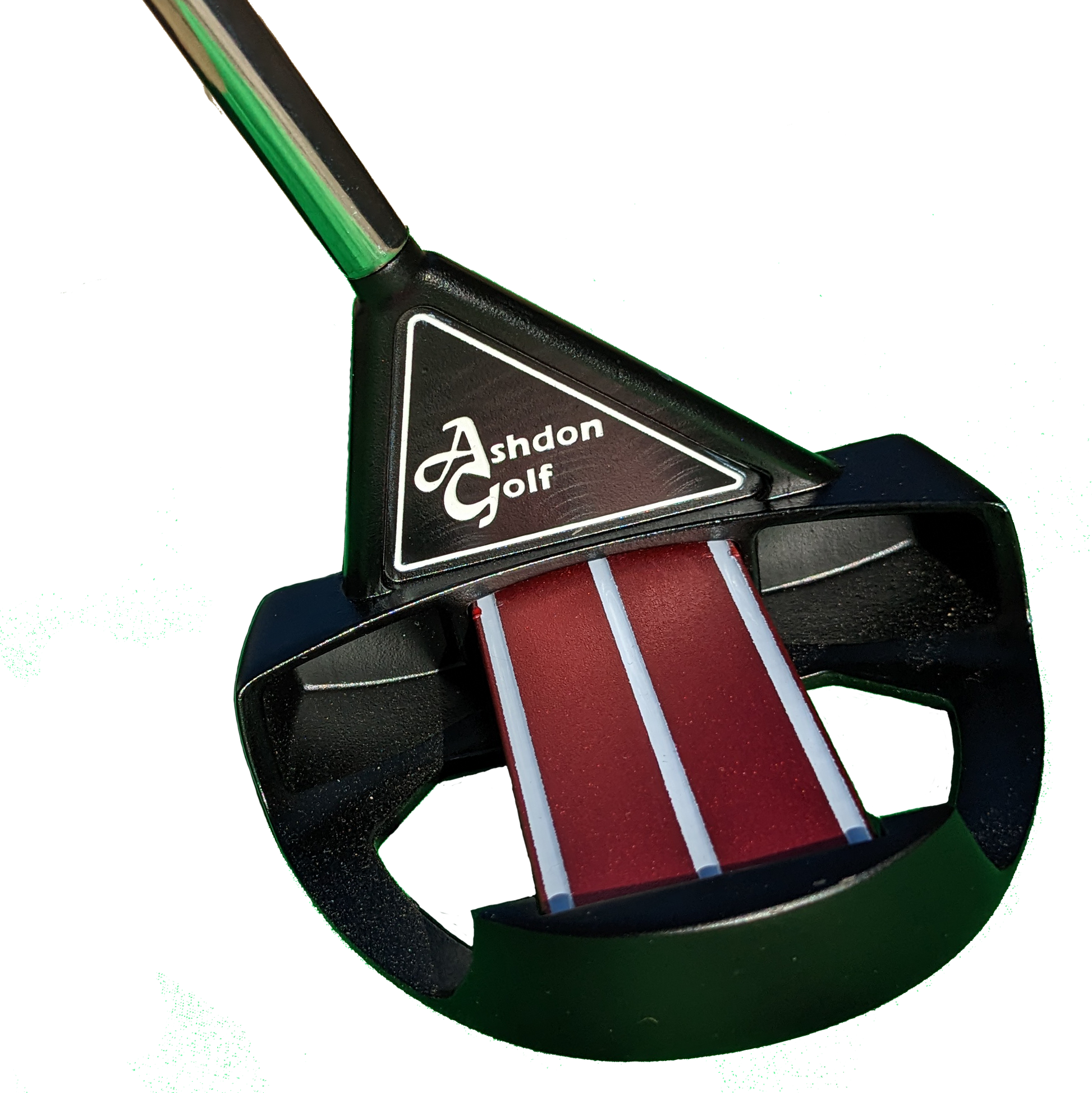
Bermuda Triangle Long Island Mallet ($299.95)
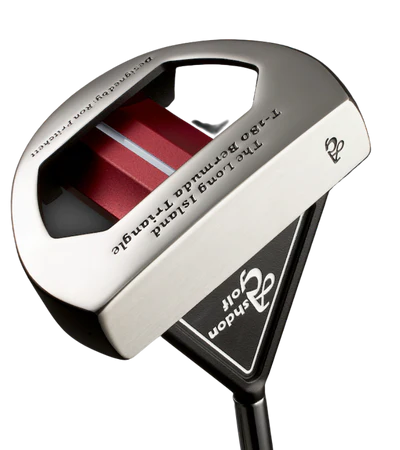
The Long Island Mallet is our best-for-beginners high-MOI design. It features the largest sweet spot of any putter in the Bermuda Triangle lineup, which means you can hit the ball anywhere inside the triangle frame and still get a solid roll.
"Line the ball up in the middle, and point-and-putt." That is the whole instruction. The engineering handles everything else.
Bermuda Triangle Grand Bahama Mallet ($299.95)
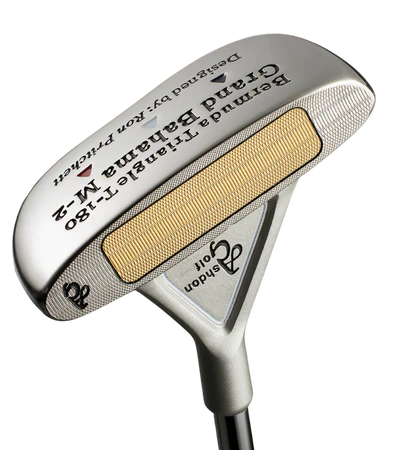
The Grand Bahama is best for golfers who want centralized mass and a smooth, controlled roll. Its 350-gram head weight sits behind the golf ball at address, promoting precise distance control on mid-range putts.
The triangle frame connects heel to toe with the same geometric rigidity as the rest of the series, keeping the face square throughout the stroke.
Bermuda Triangle Blade ($299.95)
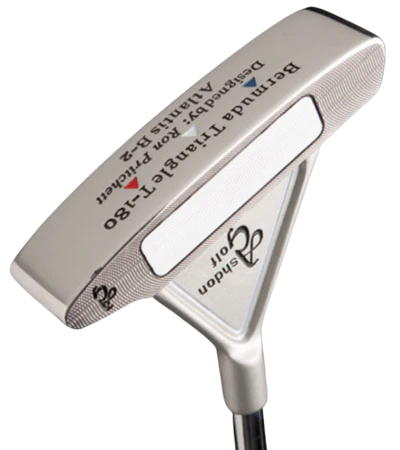
Not everyone wants a large mallet profile, but that does not mean you have to sacrifice high-MOI engineering. Our Bermuda Triangle Blade delivers the familiar blade silhouette with our full triangle-connection technology underneath.
It offers the largest sweet spot of any blade-style putter on the market, backed by the same geometric stability that defines our mallet line. Best for: golfers who prefer the look of a traditional blade but want modern forgiveness built in.
Best High-MOI Putter Designs: The Roundabout Series
Where the Bermuda Triangle series uses a triangular frame, our Roundabout series uses a circular connection exactly 1.68 inches in diameter, the precise size of a regulation golf ball. This is not decorative. The circle sits on top of the head at address and gives you an immediate visual reference for centering the ball perfectly at impact, every single time.
Point-and-putt simplicity backed by serious high-MOI putter engineering and design. That is the Roundabout promise.
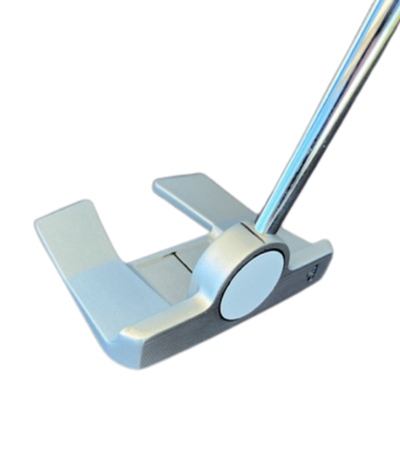
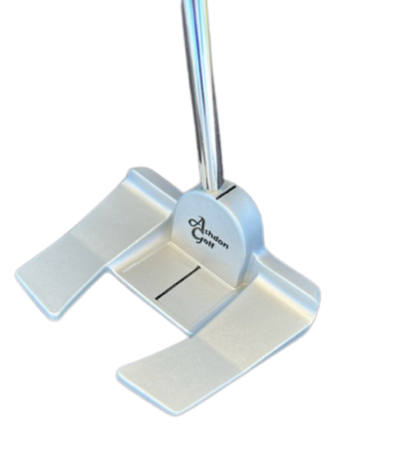
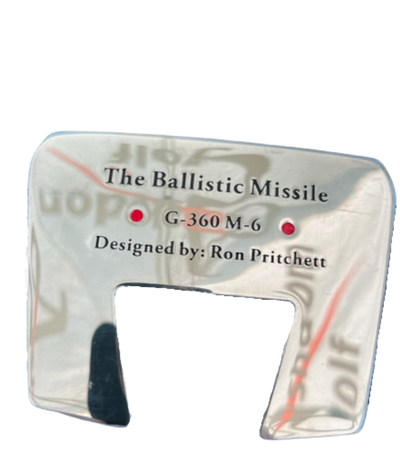
Roundabout Ballistic Missile G-360 M6 Mallet ($349.95)
The M6 is the heaviest putter in the Roundabout lineup at 380 grams. That weight, distributed to the perimeter via the circle-connection frame, produces maximum resistance to face rotation on mishits.
It is best for: golfers who want every mechanical advantage possible and are comfortable with a slightly heavier feel through the stroke.
Roundabout Blade ($298.98)
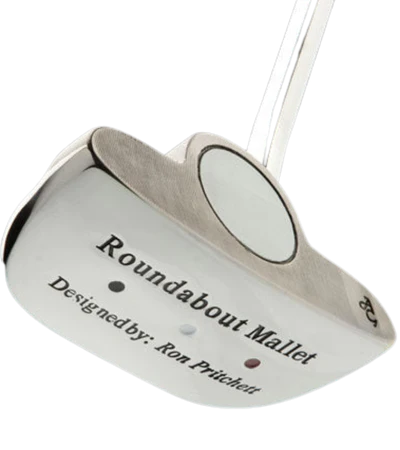
The Roundabout Blade applies circle-connection engineering to a blade profile. The circle sits at the center of the head and connects heel to toe, keeping the face square and providing a clear alignment guide at address.
Best for: experienced golfers who want high-MOI stability without the visual bulk of a mallet head.
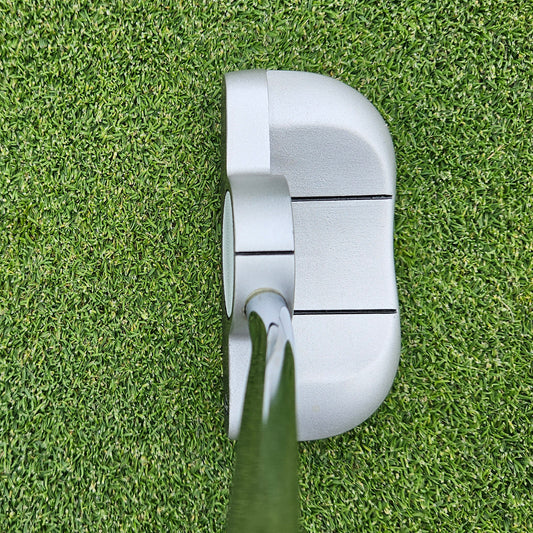
Best High-MOI Mallet Engineering: The Guided Missile Series
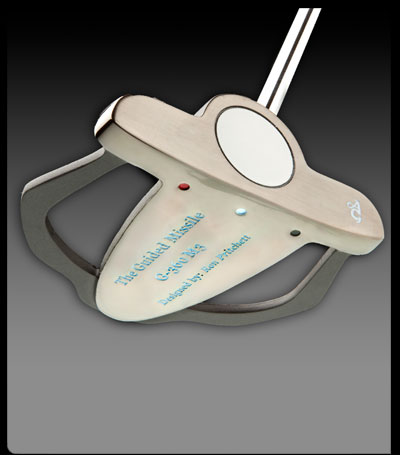
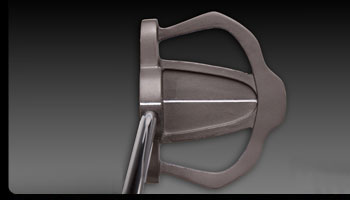
Our Guided Missile series (M3, M4, M5, M6) takes the Roundabout circle-connection concept and applies it to an elongated mallet body for even greater stability and alignment precision.
The circle connects the heel and toe of the head, creating the simplest possible address position. Look down, center the ball in the circle, and stroke. There is no guesswork, and the geometry prevents face twist from the first inch of the backswing.
Roundabout Guided Missile M4
The Guided Missile M4 is available in standard, belly, and chest lengths and can be customized to any shaft length. That level of fit matters because the geometry of high-MOI putter design works best when the shaft alignment matches your natural stance and stroke.

Roundabout Guided Missile M3
The Guided Missile M3 uses the same circle heel-to-toe connection as the M4, with a slightly different head profile for golfers who prefer a cleaner look behind the ball.
Like all our Guided Missile putters, it is available in belly and chest configurations and is fully customizable in length. Best for: golfers with a straight-back, straight-through stroke who want maximum guidance from the geometry at address.
High-MOI Putter Engineering and Design: Comparing the Two Geometric Approaches
The core decision in our high-MOI lineup comes down to one question: do you prefer a triangle or a circle at address?
|
Feature |
Bermuda Triangle Series |
Roundabout / Guided Missile Series |
|---|---|---|
|
Connection geometry |
Triangle (T-180 shape) |
Circle (G-360, 1.68" diameter) |
|
Alignment aid |
Wide triangular frame frames the ball visually |
Circle exactly matches the golf ball for centering |
|
Best for |
Golfers who want the largest possible sweet spot |
Golfers who want the simplest alignment system |
|
Head weight options |
350g (Grand Bahama) to 380g (M5) |
Up to 380g (M6) |
|
Styles available |
Mallets and blades |
Mallets, blades, belly, and chest lengths |
|
Patent/trademark status |
Indefinite trademark on Triangle connection design |
Patent-protected circle design |
|
Price range |
$299.95 to $349.95 |
$298.98 to $349.95 |
Both geometric approaches share the same foundational engineering: heel-to-toe connection, perimeter weighting, torque suppression, and USGA approval. The choice is primarily one of visual preference and stroke style.
Who Benefits Most from High-MOI Putter Engineering?
The honest answer is: almost every golfer. But certain player types see the most dramatic improvement when they switch to a properly engineered high-MOI design.
- Golfers who three-putt regularly: Off-center hits are the leading cause of 3-putts. High-MOI engineering cuts the distance penalty on mishits by up to 60%, turning potential 3-putts into simple tap-ins
- Golfers battling the yips: Our entire brand was built to solve this exact problem. A putter that resists face rotation during the backswing dramatically reduces the involuntary twist that causes yipped putts.
- Golfers who struggle with alignment: The circle-the-ball design of the Roundabout series eliminates guesswork. If the ball fits inside the circle, you are centered. That is all there is to it.
- High-handicap players: Inconsistent center contact is universal in higher-handicap play. A larger effective sweet spot means bad swings produce less-bad results.
- Experienced players seeking precision: Even scratch golfers benefit from reduced face angle variation. Users fitted for high-MOI putters in controlled testing experienced a 50% average reduction in face angle variation at impact, and face angle accounts for roughly 80% of where a putt starts.
Our over 10,000 happy golfers span all of these categories, from weekend players who just want to make more 3-to-5-footers with confidence, to competitive amateurs who need every statistical edge they can find.
Did You Know?
80% of the world's top 5 ranked men's players and the women's world No. 1 have switched to high-MOI mallet putters as of early 2026, confirming that engineering advantage has decisively overtaken tradition at the elite level.
Source: mygolfspy.com
What Makes Ashdon's High-MOI Putter Engineering Genuinely Different in 2026
There are dozens of putters on the market that claim high-MOI performance. Most achieve it through simple perimeter weighting, which is effective but not innovative. What we do is structurally different.
First, we stop torque at the source. Rather than only dampening the effect of face twist at impact, our geometric frame prevents the head from rotating during the backswing itself. No other manufacturer holds a patent on this approach.
Second, we use pure geometric strength. A triangle distributes stress across three fixed points with no weak link in the structure. A circle has no corners or edges to flex under load. These are not aesthetic choices. They are engineering decisions backed by mathematics and validated by USGA testing.
Third, our sweet spot claim is specific and measurable. We do not say our putter is "more forgiving." We say it delivers an 87% larger effective sweet spot than any other putter on the market. That figure is tied directly to the geometry of the heel-to-toe connection frame, not to marketing language.
Fourth, the design is the product of a PGA Professional's career. Ronnie Pritchett served as head professional at Indian Hills Country Club in New York, Old Westbury Golf and Country Club, High Ridge Country Club in Florida, and the Standard Country Club in Atlanta. He did not design this putter in a laboratory. He designed it because he spent decades watching good golfers lose strokes on the green to a solvable engineering problem.
The Round-A-Bout G-360 was recognized as the #1 putter in the country by Rankmark, and our entire product line is available to browse at Ashdon Golf's full collection. Questions about fit, length, or custom pricing? We encourage you to reach out directly through our contact page and speak with Ron personally.
Conclusion
High-MOI putter engineering and design is not a trend. It is the direction that professional golf has already moved toward, and in 2026, the data supporting it is overwhelming. Whether you choose a triangle-connected Bermuda Triangle mallet for maximum sweet spot coverage, a Roundabout circle design for point-and-putt simplicity, or a Guided Missile mallet for precision alignment, the geometric engineering underneath each Ashdon putter solves the same fundamental problem: keeping the face square to your target from the first inch of the backswing to the moment the ball leaves the face.
Our high-MOI putter engineering has earned over 10,000 satisfied golfers, a national #1 ranking, and several patents protecting designs that no other manufacturer can replicate. If you are ready to eliminate 3-putts and make those extra 3-to-5-footers with confidence, explore our full lineup and find the right geometric solution for your game.
Frequently Asked Questions
What does high-MOI mean in putter engineering and design?
High-MOI refers to a putter design that distributes mass to the heel and toe of the head, maximizing its resistance to twisting (Moment of Inertia) on off-center strikes. In practical terms, high-MOI putter engineering and design keeps the face squarer to your target even when you miss the sweet spot, reducing the distance and direction penalty of mishits.
Is a high-MOI putter worth it in 2026?
Absolutely. In 2026, 80% of the world's top 5 ranked players use high-MOI mallet putters, and testing consistently shows that high-MOI designs produce measurably better proximity-to-hole results across all skill levels. The performance gap between high-MOI and traditional blade designs is not a matter of opinion, it is measurable physics.
What is the difference between a high-MOI mallet and a blade putter?
A blade putter concentrates mass near the center of the head, which produces a precise feel on center strikes but significant distance and directional loss on mishits. A high-MOI mallet distributes mass to the perimeter, creating a far larger effective sweet spot and far more resistance to face twist. High-performance high-MOI designs can reach 6,000 to 9,000+ g-cm² on the vertical axis, compared to 3,500 to 6,000 g-cm² for typical blades.
How does geometric engineering improve putter MOI?
Geometric engineering, specifically using triangles and circles to connect the heel and toe of the putter head, creates a rigid structural frame that resists deformation and rotation under load far more effectively than conventional flat-back or cavity designs. At Ashdon Golf, this approach is patent-protected and produces an 87% larger sweet spot than competing putters on the market.
Can high-MOI putter design help with the yips?
Yes, and it was the original motivation behind Ashdon Golf's entire product line. By stopping torque during the backswing (not just at impact), our high-MOI designs prevent the involuntary face rotation that triggers or amplifies the yips. Golfers who have struggled with the yips for years consistently report that the geometric frame stabilizes their stroke in a way that no practice routine alone achieves.
What is the best high-MOI putter for a beginner in 2026?
The Bermuda Triangle Long Island Mallet ($299.95) is our top recommendation for beginners specifically because it features the largest sweet spot in our lineup. Any contact inside the triangle frame produces a solid roll, which means a new golfer can build confidence and consistency without needing perfect center contact from the start.
Does Ashdon Golf's high-MOI putter design meet USGA rules?
Yes. Every Ashdon Golf putter is USGA-approved and fully legal for tournament and recreational play. Founder Ronnie Pritchett spent three years working through the patent process and USGA review before releasing the first putter to the public, ensuring that all geometric engineering features comply completely with the Rules of Golf.