Head Style · Blade
Blade Putters,
Classic Look. Modern Physics.
The traditional profile, feel-first and precise — with the same Ashdon geometry that keeps the face square at impact underneath it.
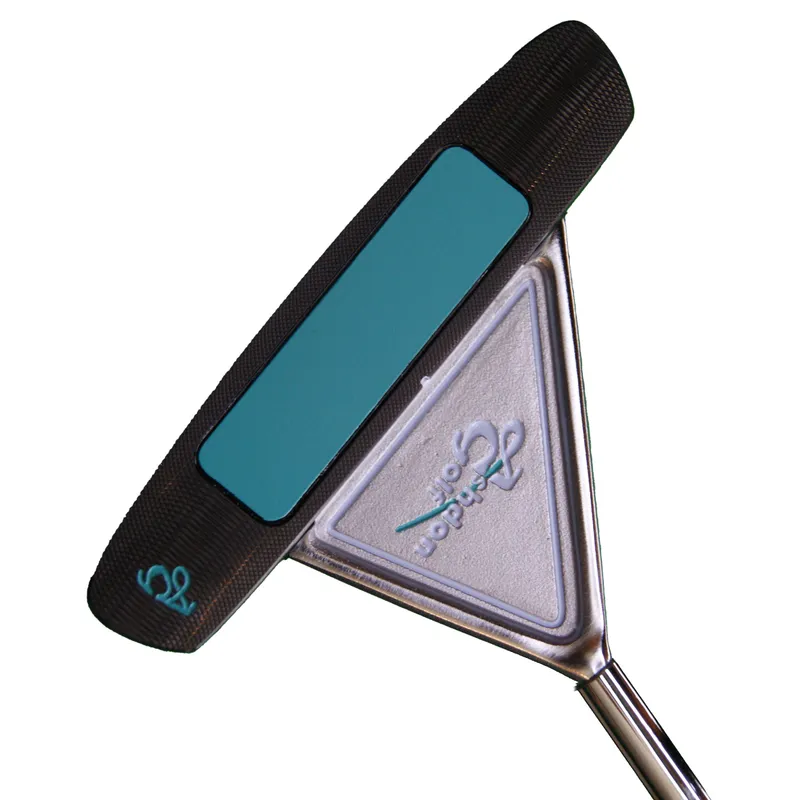
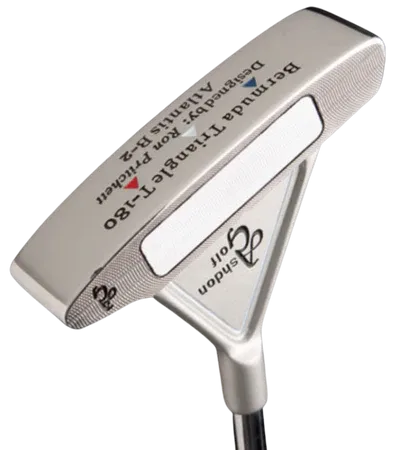
A blade putter has a narrow, traditional head profile — the classic look, with modern Ashdon engineering underneath. Blades reward a consistent stroke and typically suit players with a more arcing stroke who prioritize feel. The payoff is a pure, responsive impact that a wider mallet can't quite replicate.
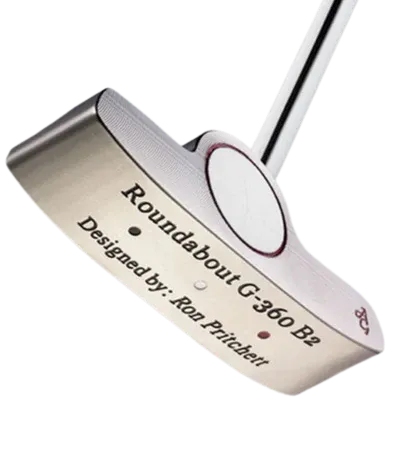
On the Roundabout Blade, the circular face measures exactly 1.68 inches in height — the same diameter as a golf ball. When that circular face meets the spherical ball, the geometry is designed to reduce bounce: the face pushes the ball forward so it starts a pure, end-over-end roll sooner, and the circle-on-circle profile gives an over-the-ball sight line for precise alignment.
A traditional profile doesn't mean giving up stability. Even in a blade, Ashdon's geometry keeps the face square and reduces torque by 87% versus conventional putters. Every head is CNC-milled from solid 303 stainless steel to tolerances tighter than ±0.001″, and every model is designed to conform to USGA and R&A rules.
Stroke Match
Is a Blade Right for Your Stroke?
The honest answer is that head shape matters less than whether the putter's toe hang matches the way your stroke moves. Everything else — looks, material, price — comes after that.
Toe hang is easy to check yourself. Balance the shaft across a finger and let the head hang free. If the toe drops toward the floor, the putter has toe hang. If the face points up at the sky, it is face balanced. What you are measuring is how readily the head wants to rotate open and closed as you swing it.
That matters because almost nobody putts on a perfectly straight line. Most strokes travel on a slight arc, with the face opening a little going back and squaring up through impact. A putter with toe hang rotates with that motion. A face-balanced putter resists it — which is exactly what you want if your stroke really does go straight back and straight through, and exactly what you do not want if it arcs.
Blades sit at the toe-hang end of that range. That is the real reason they are described as a better player's putter: not because they demand more skill in some abstract sense, but because they suit a stroke with visible arc, and a golfer with a repeatable arc tends to be a more practised putter.
| Your stroke | Wants | Head style | Why |
|---|---|---|---|
| Strong arc | Full toe hang | Blade | Face opens and closes noticeably. The head should want to rotate with it. |
| Slight arc | Moderate toe hang | Blade or compact mallet | The most common stroke. Toe sits around 45° when balanced. |
| Straight back, straight through | Face balanced | Mallet | Minimal rotation through the stroke. A blade will fight you here. |
If you are not sure which row you are in, the quickest test costs nothing: putt normally on a flat surface while someone films or watches the face from directly behind you. The amount the face opens on the backswing is your arc. The fitting guide covers it step by step, along with length and lie.
The Blades
Traditional Profile, Engineered Roll
Blade Putters, Answered
Is a blade or mallet putter right for me?+
Blades have a narrow, traditional head profile and typically suit skilled players with a more arcing stroke who prioritize feel and already have a repeatable stroke. Mallets are wider and more forgiving, better suited to a straight-back, straight-through stroke. If you are unsure, the free fitting guide matches you by stroke type.
Do blade putters give more feel?+
A blade profile is prized for its pure, responsive feel at impact. Ashdon blades pair that classic feel with modern engineering — the same geometric head design that keeps the face square and reduces torque by 87% versus conventional putters.
What is the circular face on the Roundabout Blade?+
The circular face on every Roundabout putter measures exactly 1.68 inches in height — the same diameter as a golf ball. When a circular face meets a spherical ball, the geometry is designed to reduce bounce: instead of a glancing blow off a flat surface, the face pushes the ball forward so it starts a pure, end-over-end roll sooner. It also gives an over-the-ball sight line for precise alignment.
Are Ashdon blade putters USGA approved?+
Yes — with a note on how the question is usually phrased. The USGA doesn't approve or endorse equipment; it evaluates clubs for conformance to the Rules of Golf. All Ashdon putters are designed to conform to USGA and R&A equipment rules and are legal for tournament play at all levels. That covers every blade in the current lineup. The Roundabout Series geometric head design was first patented in 1994 (U.S. Patent US5599241A, expired 2014).
What is toe hang on a putter?+
Balance the putter shaft on your finger and let the head hang. If the toe drops toward the ground, the putter has toe hang. If the face points at the sky, it is face balanced. Toe hang tells you how readily the head wants to rotate open and closed through the stroke — and that is what needs to match your stroke. Blades typically have more toe hang than mallets, which is the main reason they suit arcing strokes.
How much toe hang do I need?+
Match it to how much your stroke arcs. A strong arc — the face opening noticeably going back and closing through impact — wants more toe hang, often a full toe-down hang. A slight arc wants moderate toe hang, roughly the toe sitting at 45 degrees. A straight-back, straight-through stroke wants little or none, which usually means a face-balanced mallet rather than a blade. The quickest way to find your arc is to putt normally while someone watches the face from behind you.
Should I choose an insert or a milled face?+
A milled face is cut directly from the head material, giving a firmer, more acoustically direct impact and clearer feedback on where you struck the face — which is why it pairs naturally with a blade. An insert uses a softer material in the face to dampen impact, which some players prefer on faster greens or with a firmer ball. Neither rolls the ball measurably better; it is a feel and feedback preference. Ashdon blades are CNC-milled from solid billet.
What length blade putter should I use?+
Length matters more than most golfers expect, and most play a putter that is too long. The right length puts your eyes over or just inside the ball with your arms hanging naturally and your shoulders level. As a starting point by height: over 6 feet is usually 36 inches, 5 feet 8 to 6 feet is 35 inches, 5 feet 4 to 5 feet 8 is 34 inches, and shorter players are typically 33 inches or less. Posture changes this, so treat height as the starting point rather than the answer — the fitting guide walks through it properly.
Other Categories
Compare Head Styles
Zero-Torque
Geometry that resists twisting — 87% less torque than a conventional putter, so the face stays square.
View Zero-Torque Putters →Mallet
More mass, further from the center. The largest, most stable head Ashdon builds.
View Mallet Putters →High MOI
Geometric mass distribution that resists twisting on off-center hits.
View High MOI Putters →Not Sure Which Model?
Find Your Fit
The free fitting guide matches you to the right Ashdon blade based on your stroke type, height, and tendencies.
Get Fitted